
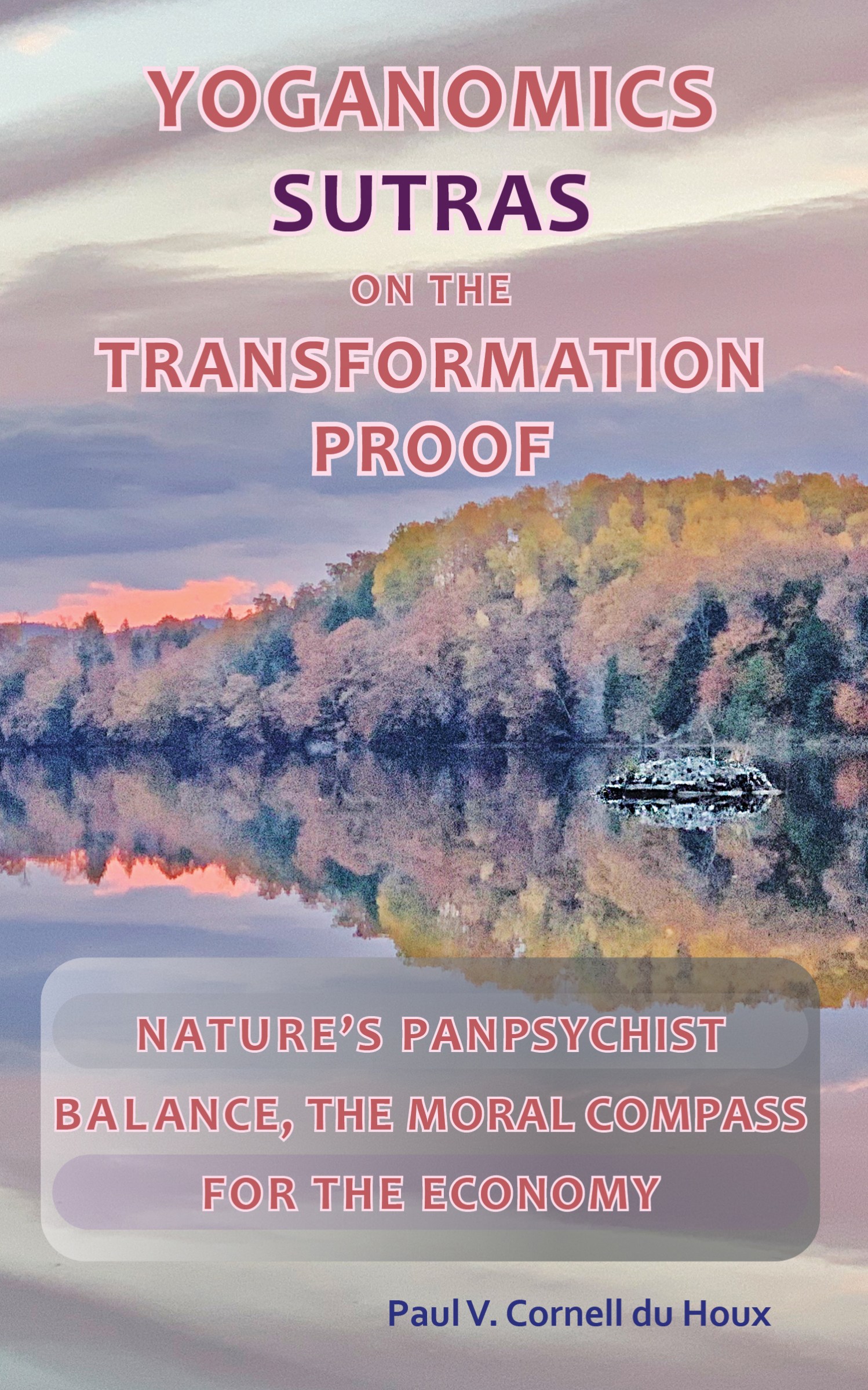
Unicycle, the Book of Fictitious Symmetry and Nonrandom Truth, or the Panpsychist Asymmetry of Nature’s Democratic Pi
Endorsements
“Very scrupulously set out. It is extremely well written and beautifully literate.” —Dr. Diané Collinson, author of Plain English, Fifty Major Philosophers, Fifty Eastern Thinkers, coauthor of works including the Biographical Dictionary of Twentieth-Century Philosophers
“This book contains some serious mathematics—smart, thought-provoking, and engrossing.” —William H. Barker, PhD, Isaac Henry Wing Professor of Mathematics, Chair of the Mathematics Department, Bowdoin College, coauthor of Continuous Symmetry: From Euclid to Klein
“A provocative book by a serious thinker, well worth the reader’s time.” —William A. Haviland, PhD, Professor Emeritus, founder of the Department of Anthropology, University of Vermont, coauthor of textbooks including the bestselling Evolution and Prehistory: The Human Challenge, and Cultural Anthropology, author of At the Place of the Lobsters and Crabs: Indian People and Deer Isle, Maine, 1605–2005
“An eloquent explanation, with spare logic and excellent argument. In my critical thinking class, my students study the core ideals of the Enlightenment; this book’s world view gives me a position from which to triangulate between absolutism and relativism and illuminates all three.” —David S. Cook, MSc, author of Above the Gravel Bar: The Native Canoe Routes of Maine
“It’s an important book. I am very impressed. It covers a lot of territory, and it is very thoughtful and even charming. The math and logic are understandable to the interdisciplinary reader. I agreed with everything the book has to say.” —Esther Pasztory, PhD, Lisa and Bernard Selz Professor Emeritus in Pre-Columbian Art History and Archaeology, Columbia University, author of groundbreaking books including, Thinking with Things, Aztec Art, and Teotihuacan: An Experiment in Living
______________________
Fundamental Polarities of Change (Back cover transcription)
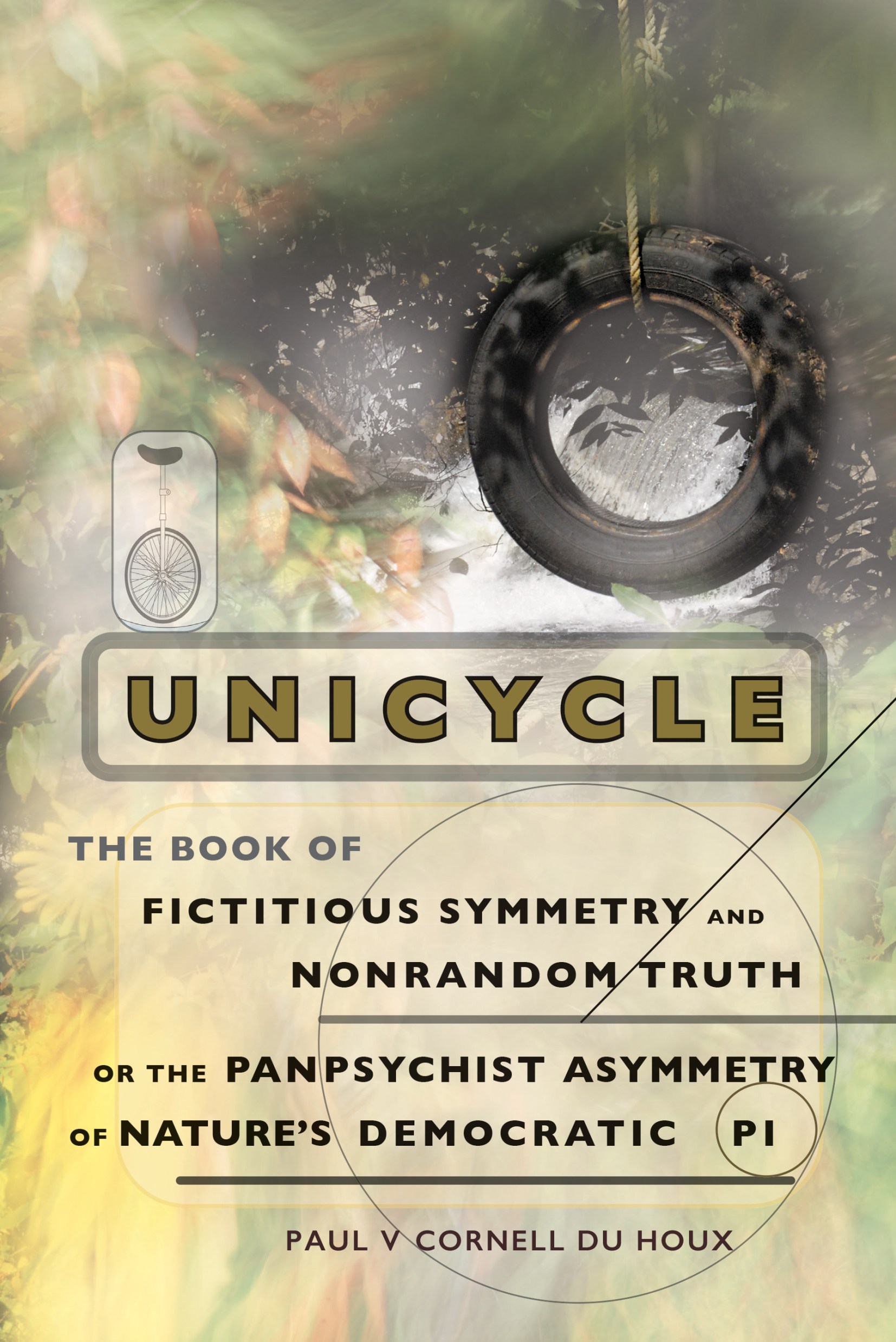
The unicycle provides a singular image of balance and impending peril, lifted by whimsy for the weighty subject of this book. All the evidence of experimental science reveals that nature is asymmetric. No pure symmetry has ever been found. What does it mean to live in an asymmetric environment?
Unicycle introduces the logic of asymmetric polarities of change to interpret the evidence, while showing how our symmetry-based math has failed to grasp a vital ethical and physical connection between humanity and the environment, between mind and body.
The observation that nature is asymmetric confirms reasoning that is as organized as the current foundational symmetries of math by using symmetry as a foil in a proof by contradiction. One result is the discovery that nature, the universe, has a nonrandom sense of direction with vital ethical consequences, as matter and conscious behavior fundamentally combine in changing polarities and degrees.
Humans are drawn repetitively, even addictively, to pure symmetry in the fictitious simplicity of absolutes, like moths to the flame, gamblers to roulette, or — clowns to the unicycle. The more extreme the instability, the greater the need for balance. There is a Tao-like polarity — but one where absolute poles of chaos and order cannot exist.
Where physical and social pressures cannot go, they must turn away, in the absence of absolutes, not into relativism, but into the natural, open-ended polarity of the River of Asymmetry. Self-defeating actions attract asymmetric counter-pressures. A self-centered monoculture needs to reach out for balance and learn to navigate the currents.
A key finding is that symmetry and asymmetry are mutually exclusive. In the absence of absolutes, nature’s asymmetry opens a creative continuum of opportunity that cannot be stopped with absolute finality. That which connects us is more profound than the differences that divide us. Nature’s asymmetry is multifarious and fundamentally inclusive. This provides the ethical basis for a democratic society and a fresh, panpsychist understanding of natural law.
The reasoning is elucidated with an interdisciplinary narrative fiction, including mythological tales. The stories gain a realism of their own through the deductions. Nature comes to life, along with the characters, as they work on the book by a river in Maine — discovering Mother Nature’s moral compass.
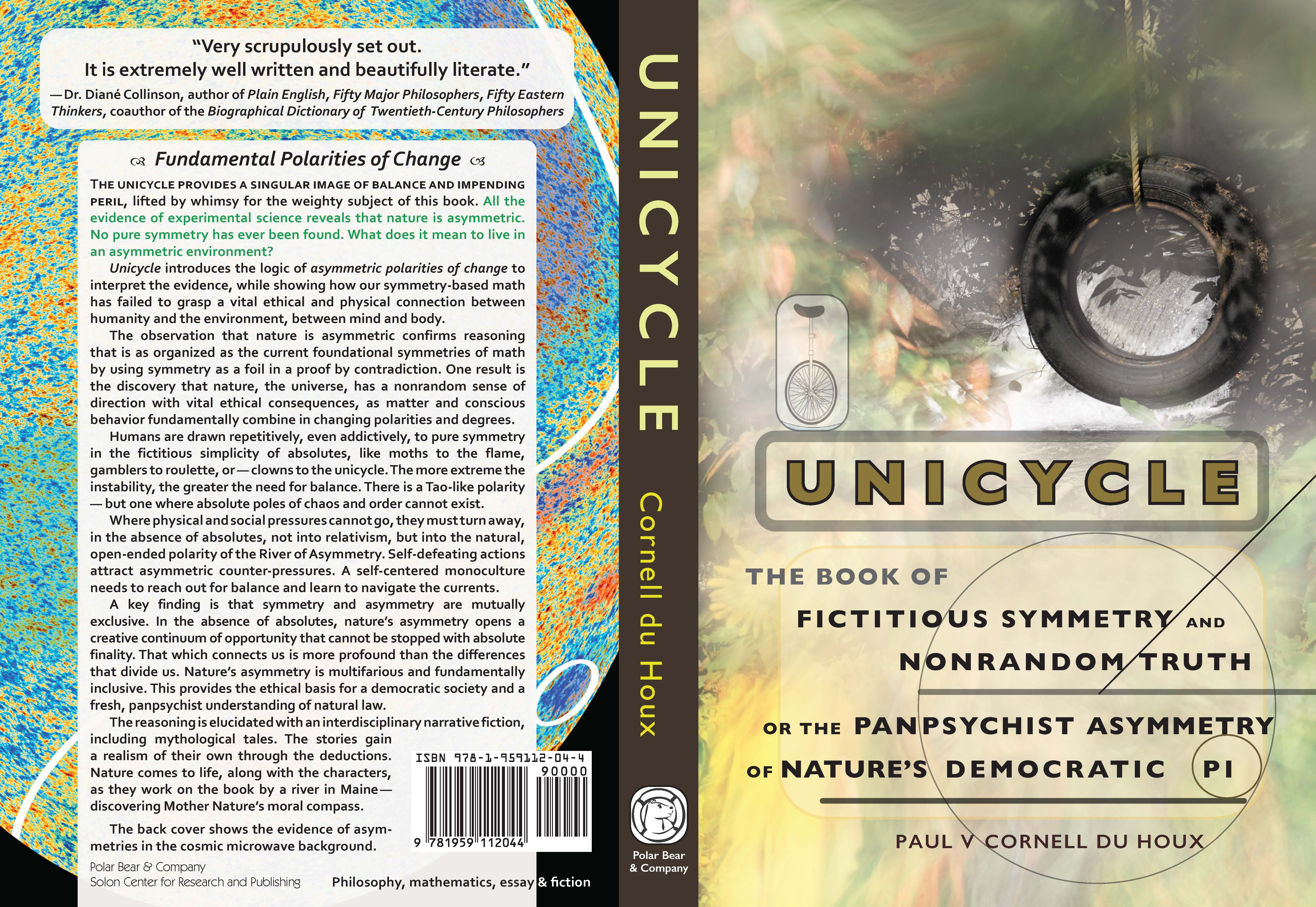
Fifth edition, January 22, 2023
The cosmic microwave background (CMB) image has been adapted to the cover design of Unicycle, courtesy of the European Space Agency and the Planck Collaboration. The full image and more information is provided via this link.
CONTENTS
Preface xi
Author’s Note xv
Acknowledgments xix
Of Myth and Reason xxiii
I. Preamble
- Samuel’s Introduction 3
- The Maze Tale 8
- The Ancient Paradox 10
- Definitions of Asymmetry 14
II. Changes
- I Revisit the Transformation Proof 19
- The Gnome and the Onion 28
- Salmon Barbecue 41
- Alice Disproves God and Deduces the Soul:
Out of the Box of Everyday Awareness 46 - Alice Disproves God and Deduces the Soul:
Nonrandom Multifarious Polarity 58 - Alice Disproves God and Deduces the Soul:
Fundamentality 66 - Samuel Passes the Torch 71
- “At the Pearly Gates,” by Rolo 73
III. River of Asymmetry
- Transition 79
- “The Lady of the Lake or The Rings of Pi,” by Rolo 81
- “Context and Induction,” by Lola 91
- “Totalitarian Math,” by Rolo 97
- Manitous 103
- Samuel’s Essay: “Extremely Low Asymmetry” 109
- Samuel’s Essay: “Which Number Two Now?” 115
- Samuel’s Essay: “More About the Absence and
Something About Set Theory” 117 - Samuel’s Essay: “The Largest Number Proof, Etc.” 132
- “The Jinniyah and the Greatest Number,” by Rolo 161
V. Aquilah and the Lamp, by Lola
- “Awakening” 171
- “Genies in Bottles,” by Rolo 174
- “Quill Pen” 180
- “Aquilah’s Essay” 185
V. The Tea-Room Scenarios
- By the River 195
- “Infinity and The Book of Changes,” by Rolo 198
- Alice at Tea 208
- “The Gingerbread Variable,” by Rolo 222
- Molly 230
- “The Sources of Plato’s Opinions” from
A History of Western Philosophy, by Bertrand Russell 234 - Streams of Paradise 238
- Atlas Speaks 246
VI. Stirring the Pot
- “The Asymmetric Economy” by Anonymous Economist 261
- “Asymmetric Evolution” by Extraterrestrial
High School Teacher 273 - “Philosophical Habitat” by Interplanetary Inhabitant
of No Fixed Abode 291 - Snagged by the Imperfect Democratic Tao of Pi 314
- Nature’s Democratic Counter-Pressures 316
Notes 319
Selected Bibliography 323
The Author’s Story 325
Author’s Note from Unicycle
At the end of his philosophical comedy, Religulous, Bill Maher says we must either “grow up or die.” In pursuit of a few basic answers I have been attempting, somewhat paradoxically, to take his advice most of my life. When we stop growing up we become the posturing “adults” I used to watch and wonder at as a teen. These adults seemed to think they had all the answers—and so many teens are pressured to look jaded, like they’ve seen it all. I didn’t want to grow up like that. But I loved fairy tales as a child, and later on I realized that this was also called “folklore” (a more grown-up expression) and “mythology,” which was religion when the human race was even younger than we are now. Isn’t there some way to grow up and still believe enough for the stories to be true enough, so we don’t have to leave it all behind and become “adults”? Adults who believe in fairy tales?
When I hear of a suicide bomber who murders men, women, and children with the idea that he or she will go to a paradise of ancient lore, it is like hearing something too horrible even for the Brothers Grimm or Lord of the Flies. When I hear a leader declare something like a crusade or jihad against another system of belief in folklore and mythology, I get that same feeling of children killing each other. In a sense, the terrorist, no matter how frightening, never got into growing up. While that may not be much of an excuse, lack of that particular excuse does not mean there is no shared responsibility. How many of our elders are responsible for the stories we tell?
But they are just stories, are they not? The power of what can seem nothing more than an idea or a fairy tale can be vast and projected over thousands of years by the force of human nature when it becomes religion. Without wishing to sound too responsible, I feel it’s a matter of citizenship to tell each other stories in ways that clarify and question where the fiction might be—and the truth—and that leave opportunities for the next storyteller to come along. As a publisher it has especially been my mission to contribute to the process of growth that keeps at bay the self-arrogation of “absolute truth” that confuses our grownups and children alike.
I have been fortunate in having some teachers who were so good that I began to get the sense that it might be possible continuously to advance the frontiers of the discovery of the truth in fiction and of the fiction in reason. Experiences in literary analysis encouraged me to wonder if it might not be possible truly to identify the greatest fictions of all in our most powerful mythologies—even to the logical uncovering of God Himself as a character in a long-standing story. The fact that God is regarded by many as so obviously a fictitious character does not, of course, make it so. Meanwhile my love of mythology would not be satisfied with an empty character. The problem was worse that I had thought.
Characters must be believable. This means there must be truth in them. Otherwise their credibility is only based on our gullibility. That’s not good enough for good fiction, let alone great works. I feared that to close the door on the credibility of the God of monotheism, for example, as mythology or otherwise, was to empty fiction in general of credible characters. Not because the character of God is so important to fiction, but any test that could be used to empty God of truth could be used on other characters as well. And what about us? Literature would become a paltry thing to be enjoyed only by the naïve or the cynical, who are in many ways closely related in decadence. How would the credibility of any individual survive? We can see these complicated interactions as we hear concerns about the infantilization of a proud American people dumbed down to a monoculture by cynical overachievers.
“King and country!” where God is king, is too often the result, with the rule of law in subservience. The problem has long been to find a reason for democracy, especially now to counter a culture of unreason. Violent revolution, though necessary in the Age of Reason, is no longer so rational an option with weapons of mass destruction.
But a logical reason for equal opportunity requires that elusive connection between nature and democracy alluded to in the Declaration of Independence as the “Laws of Nature and of Nature’s God,” where “we hold these truths to be self-evident,” though we had not been able to prove them intellectually. Quite the opposite; philosophers cleaning up the reasoning of their predecessors increasingly identified errors in the attempt to draw ethical conclusions from observations of nature.
After many spare moments untangling these conundrums, I have finally got the following results to present for your consideration. The questions involved are fundamental enough to require a varied exposition, where God may no longer seem so prominent in the maze.
Chapter 38 of Unicycle: Snagged by the Imperfect Democratic Tao of Pi
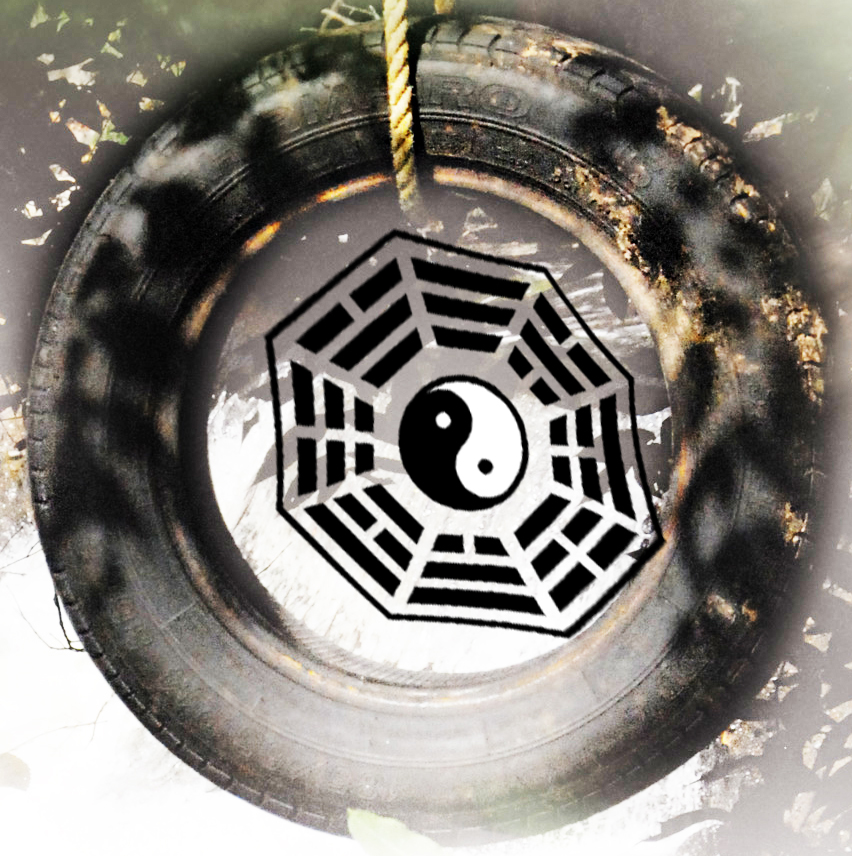
Pi is the relationship between a circle and its diameter. Sounds simple. But it’s not really a simple fact that the diameter fits into the circumference 3.14 times — that will not quite do it, will it! — There’s a snag. All those decimals in a tangle: 3.141592653… and on and on and on, and will they ever let go! After all that’s been said in this book, Murphy’s law of land and sea simply advises us that if something can snag, it will snag. A rope round a protrusion, even in calm weather, an electric lawnmower cord on a smooth rock, we have our favorites.
Something obtuse about natural law seems to invite things to snag on things. And so I will venture the thought that, in spite of the trouble, it might be a good thing. Without this unruly attraction, what could connect? Not that everything that connects need be called a “snag,” but the point is that the snag was not the destination. Had we someplace in mind? some objective that was presumed snag-free?
The surprising thing about pi is that we are alerted against thinking the circle is perfect, that it will come clean. The decimals of pi are a string of red warning lights. Endlessly imperfect! That the circle will not close absolutely is re-enumerated in all sorts of ways, no matter how we pull on it — but it does get our attention. It’s got traction.
In the absence of perfection, the circle connects with things; it snags many things in the real world and in the imagination. But it can be unsnagged if we find where it connects, so we can stop pulling on more decimals, stop counting pi, and be aware of something else. How many decimals must we endure before we cave and admit that there are no absolutely perfectly symmetrical circles, no absolutes at all, in fact, in the absence of any perfectly, finally, straight lines for diameters? Pi calls out echoingly that infinity is a snag, mathematically, metaphorically, and otherwise. It is snagging the loftiest physicists. Where the rubber meets the road, pi provides useful traction when viewed realistically. Experimental science has not found any pure symmetry in nature, at all. Walk outside and find me just one thing that does not imperfectly imply circularity — even in your ruler.
Just when you think you can identify symmetry in a flower, in a leaf, there is a snag, one of the petals is askew, and that is a beautiful thing — nature’s true balance. Another beautiful aspect of pi is its call to democracy. We can share the democratic pi(e) in a balanced way by getting inspired by nature’s gifts. How does the circle snag democracy? The number pi snags the mind into the natural world, in spite of our presumptions and with no need to be familiar with the snagger. Individuals are brought together, not into a monoculture of symmetrical banality, but into a potential flourishing of character, one and all.
This notion of a dancing, changing, balancing polarity in circles is of course not new, and is renewable in time. The ancient understanding of the polarities of the Tao have long been applied to relationships of a circle, where Yin and Yang move round each other. So do not be snagged by an illusion of some ideal symmetry in the famous Yin-Yang symbol! As the I Ching, the Book of Changes, foretells in the natural cycles of the lines of its well-weathered hexagrams, absolutes are overturned, preemptively snagged, I would add. The connections between the seasons and the livelihood of the people had deep and long-recognized roots in the planet, way before it was widely known to be round.

The vital questions of how to live and behave as humans among the forces of nature, what is right and wrong and what works and what fails in life, these issues have long focused the mind as it developed. Does nature have a moral compass? Should we follow it? If so, how? But these questions have begun to look dated, and we have become jaded. We need to be snagged by more democratic pi all round (puns included)!

 River of Asymmetry
Trackbacks & Pingbacks
Comments are closed.