
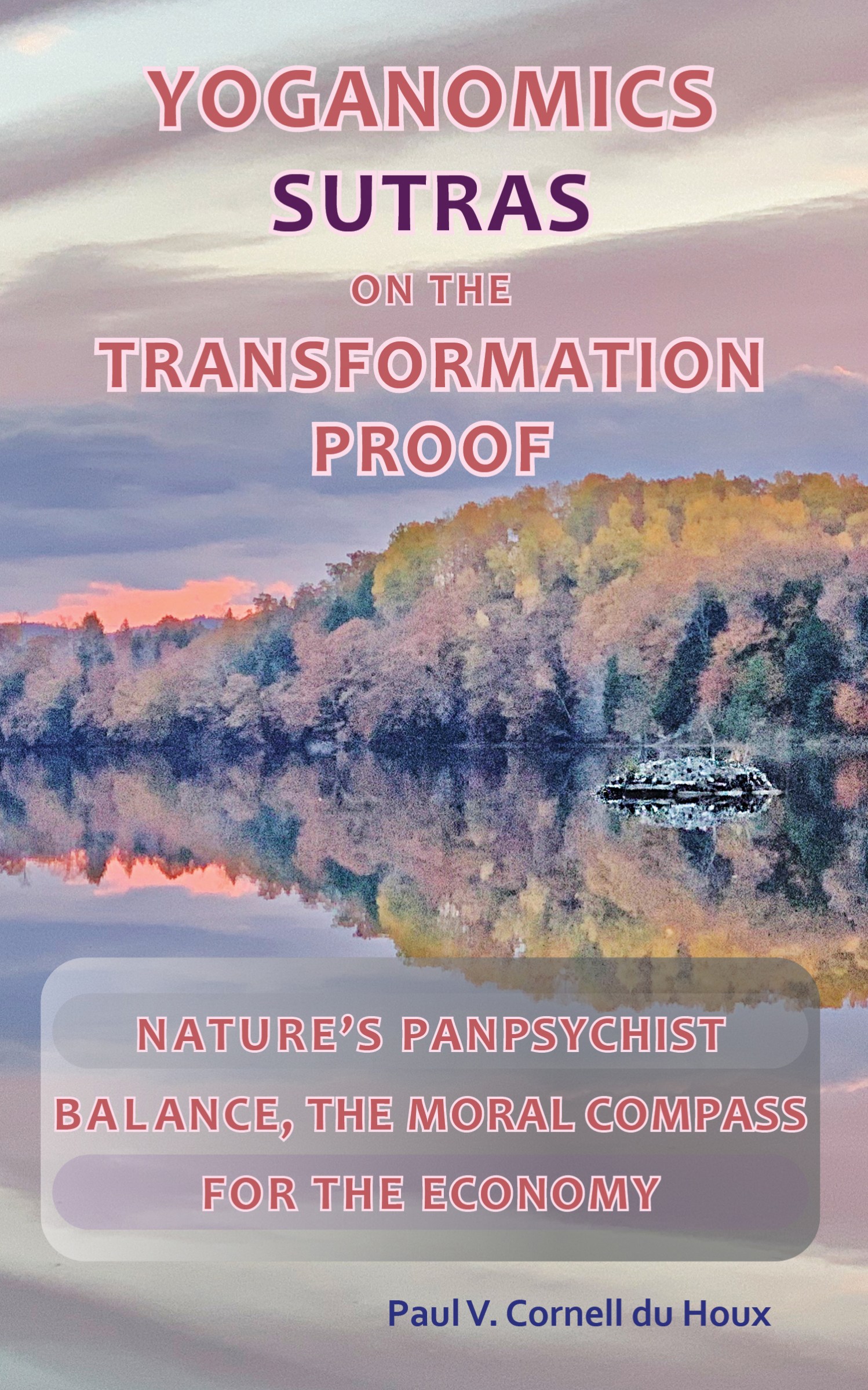
Yoganomics Sutras on the Transformation Proof: Nature’s Panpsychist Balance, the Moral Compass for the Economy (5th edition, March 2024)
All the evidence of experimental science reveals that nature is asymmetric. No pure symmetry has ever been found. The Transformation Proof shows why. What does it mean to live in an asymmetric environment? A breakthrough logic of asymmetric polarity reveals that nature has a democratic, panpsychist, moral compass that invites a yogic understanding of how the economy should live and breathe with the planet. Discover this Asymmetric Pressure Principle!
A book of environmental and climate justice with the discovery of nature’s fundamental moral compass through a new panpsychism.
Yoganomics unfolds an innovative solution to the famous “hard problem” of the relationship between nature and consciousness, mind and body, and the naturalistic fallacies, step by step, in the style of the ancient sutra for deductive clarity. The Transformation Proof and its corollary, the Asymmetric Pressure Principle, are presented with a new logic of asymmetric equilibrium change. The body of the economy needs to breathe in a healthy, rhythmic polarity. A comparison would be with nature’s asymmetric pressures that allow sailing, surfing, flying, skiing, windmills. Congestive monocultures of absolutism must be liberated with the understanding that nature is fundamentally inclusive, as the River of Asymmetry runs through it. In color inside and out, with 28 illustrations.
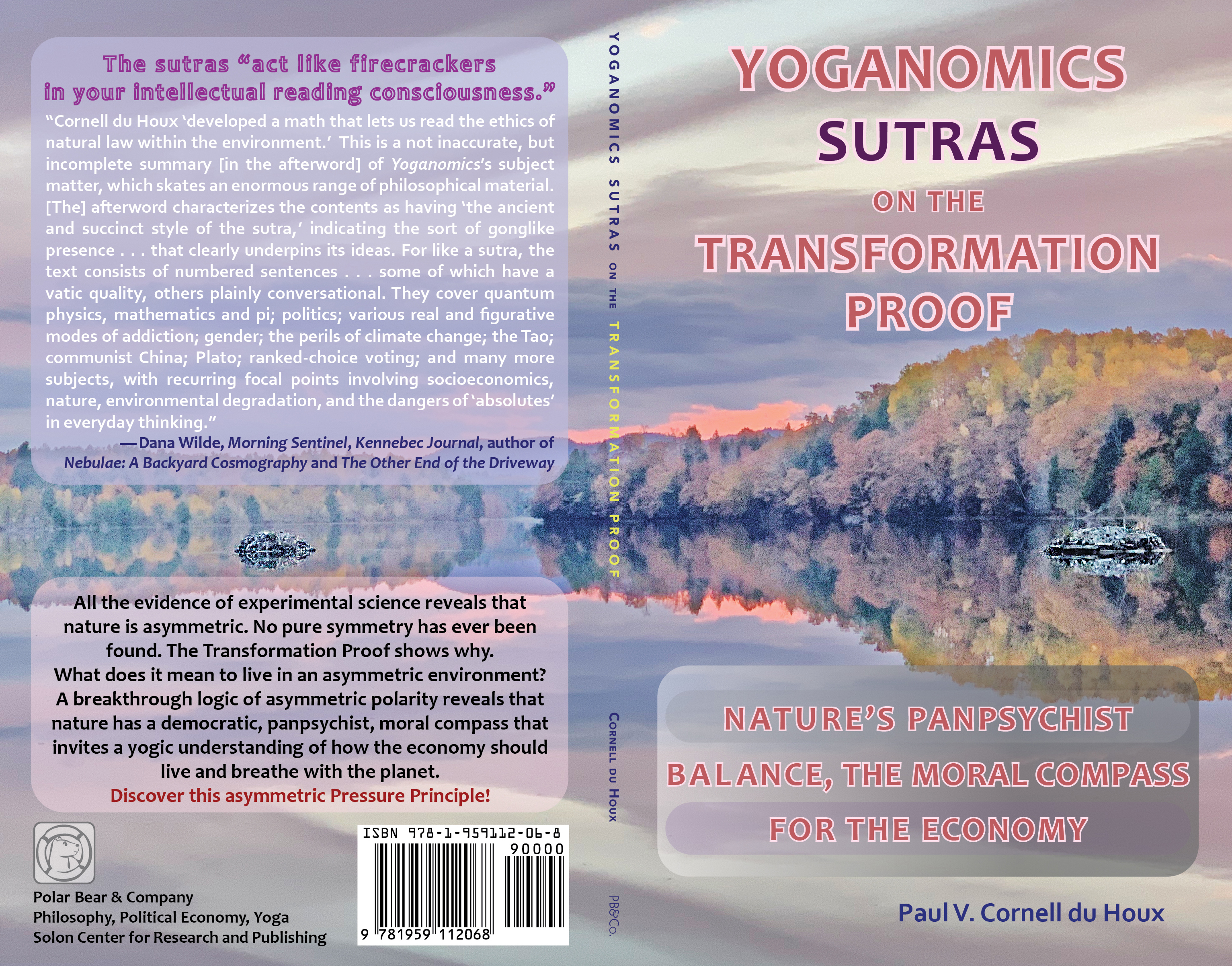
Fifth edition, March, 2024
eBook edition, April 2025 at Amazon.com
eBook and Hardcover at Barnes & Noble
Paperback edition:
Sherman’s Maine Coast Book Shops
The sutras “act like firecrackers in your intellectual reading consciousness.”
“As explained [in the afterword] ‘Cornell du Houx “developed a math that lets us read the ethics of natural law within the environment.”’ This is a not inaccurate, but incomplete summary of Yoganomics’s subject matter, which skates an enormous range of philosophical material. [The] afterword characterizes the contents as having ‘the ancient and succinct style of the sutra,’ indicating the sort of gonglike presence . . . that clearly underpins its ideas. For like a sutra, the text consists of numbered sentences . . . some of which have a vatic quality, others plainly conversational. They cover quantum physics, mathematics and pi; politics; various real and figurative modes of addiction; gender; the perils of climate change; the Tao; communist China; Plato; ranked-choice voting; and many more subjects, with recurring focal points involving socioeconomics, nature, environmental degradation, and the dangers of ‘absolutes’ in everyday thinking.”
—Dana Wilde, Morning Sentinel, Kennebec Journal, author of Nebulae: A Backyard Cosmography and The Other End of the Driveway
Preface: Wu wei is based on ancient ideas of pure motion, effortless action. Among its various interpretations, there are themes of symmetrical perfection, laissez faire, and patrician morality. Forty-five years ago, I was in my late twenties polishing my first attempt at this book, entitled Yoganomics: Pure Motion and the Law of Economic Erosion. I had come across some of the ideas of wu wei in my research, though I would not have been able to give it a name. Many practices of meditation and effortless, spontaneous action had become current by the time I was an undergraduate in economics and French in the early 1970s. And given the beguiling ubiquity of idealized motion and symmetry as modeled with calculus in economics, I was lured into a quest for reality.
Fed up with academic economics and having taken what may have been one of the last available history-of-economics courses in the United States, I decided to “launch myself from my ivory tower into the marketplace and see what most people were really doing so much of the time in their lives—at work.” That was my repeated rebuttal to doubts as to why I wasn’t going to graduate school. I would investigate demand and supply firsthand and write something as a result. Also, this would prove a good sequel to my grass-roots, East Coast student activism.
But once written, I increasingly treated my Yoganomics with the ambivalence and skepticism suitable to the whimsical portmanteau. For one thing, I had been trained to be more rigorous than to throw around words like “law” in connection with this and that.
Even so, I began to experiment with a sort of wu wei at work in London’s business Square Mile, writing currency reports with an economics consulting firm. Then I got more down to earth with the old Price Waterhouse & Co., UK, as a dogsbody accounts auditor in a wide range of work environments. And later, in sales and marketing, in two computer companies (after a stint studying law at the Inns of Court), with a side hustle attempting a couple of start-ups (in import-export and as co-inventor of an electrical connector—long story). Eventually, there weren’t many streets in London and points south where I didn’t recognize a doorway of some sort in my education on the economy.
Noticeably meanwhile, wu wei in various guises was filtering into company training courses as the New Age got traction. So Yoganomics did take on a life of its own, though in unexpected ways—these old, powerful ideas have their own ways of sweeping us along, regardless.
In my academic, economics ivory tower, and given my personal background, what I had not understood was the way effortless pure motion encourages attitudes of the moneyed lifestyle.
O course, not only rich people have been attracted by the idea of an economy where money just happens most efficiently by itself—especially if you abide by a code of ethics—like a mindfully, effortlessly received income of “rents” on capital. The wu wei of self-righting markets that would validate your meritocracy is in fact widespread. And the belief that you can “manifest” wealth is always welcomed by many, not to overly mention the prosperity gospel.
Why didn’t I know about the historic and powerful, enduring roots of laissez faire, east and west? And its predictive tentacles of the obverse ethic of prideful workaholic perfectionism? One might as well ask why the economics department of such well-endowed liberal arts colleges as Amherst couldn’t hold the moral high ground over admittedly well-funded forces of right-wing taboos. Why not enlighten us on the historical trail of wreckage, the centuries of suffering, left by laissez faire in its various formulations? As pointed out by Karl Polanyi throughout his book, The Great Transformation (1948), advocates of a self-regulating, laissez-faire economy have long toiled for governments to intervene on their behalf.
It would have been handy to know that the neoliberal Washington Consensus was being glued together with habits of thought that are finally being recognized as undergraduate “economism” or “101-ism.” God forbid we should learn that the symmetrical foundation of self-righting demand-and-supply markets are a chimera that has been fought for centuries! And still needs to be opposed and shown for the self-centered, self-contradictory beast that it is, one that feeds off the poor and lower-middle classes with special appetite
Nationwide, right-wing pressure campaigns swept away The Elements of Economics (1947) by Lorie Tarshis—the first economics textbook widely in circulation in the United States—as being socialist. The pseudo-Keynesian Samuelson compromise still fails to fill the void. Paul Samuelson’s bestselling textbooks might claim to have enough mathematics to let the trustees of universities sleep soundly, protected by dreams of scientific neutrality in their economics departments. But the void remains.
The symmetrical demand-and-supply scissoring of economics away from the past has left echoes that I believe many of us still feel, without being able to give them a name. The economics models developed in graduate schools still carry ingrained assumptions of utopian symmetries of prefect competition, to be crafted to fit the harsh realities of human behavior. Economists intervene in their own utopias, even as the politicians who have taken an undergraduate course or two in economism pressure democracy to let the economy leave the poor alone; they impoverish the populace with historic transfers of wealth off our backs and into the offshore accounts of heroic recipients.
Sensing the emptiness in my undergraduate economics—if not yet the abyss we all face today—I checked out the humanities for another perspective. Along with my French literature courses, I explored the anthropology department. There, I discovered cultures that had developed yoga, a name I could recognize. The liberal arts education came to my rescue. I practiced yoga and finally quit smoking. With or without causation, that was a powerful experience of addiction and illusion.
I don’t know how the word “yoganomics” came to me, exactly. Grandfather Vance Dunn, an Irish Kansas farmer, popular orator and storyteller, had an entire alternative German nonsense language that he employed for the benefit of his in-laws, peppered with probable English. Plus, it was the early 1970s. Then “Reaganomics” resurrected more zombies of laissez-faire in the 1980s, and subsequent presidencies got burdened with the portmanteau, as the selfishness became a consensus on bootstraps and “government interference.”
The Transformation Proof came to me during years of long walks along the Kennebec River and swimming in the wild, finally to be worded into Unicycle by 2007.
It’s true that many failed attempts have been made to connect human morality with the physical universe. What ought we to do when we look around us? Students of this subject are familiar with the naturalistic fallacies. We human animals have long claimed that nature has or has not a moral compass and that someone is or is not on the right side of truly awe-inspiring and often frightening realities. We are, after all, in nature, and we have various moralities. Where is the definitive dividing line, if any, between us moralizers and the rest of it?
It seemed to me that, being immersed in nature, it was only a matter of time and science before we reasoned it out. The question turned out to be more difficult than at first sight. Gods of nature have often been thought to keep empires in power. So one needs to be open to failure, in the scientific tradition.
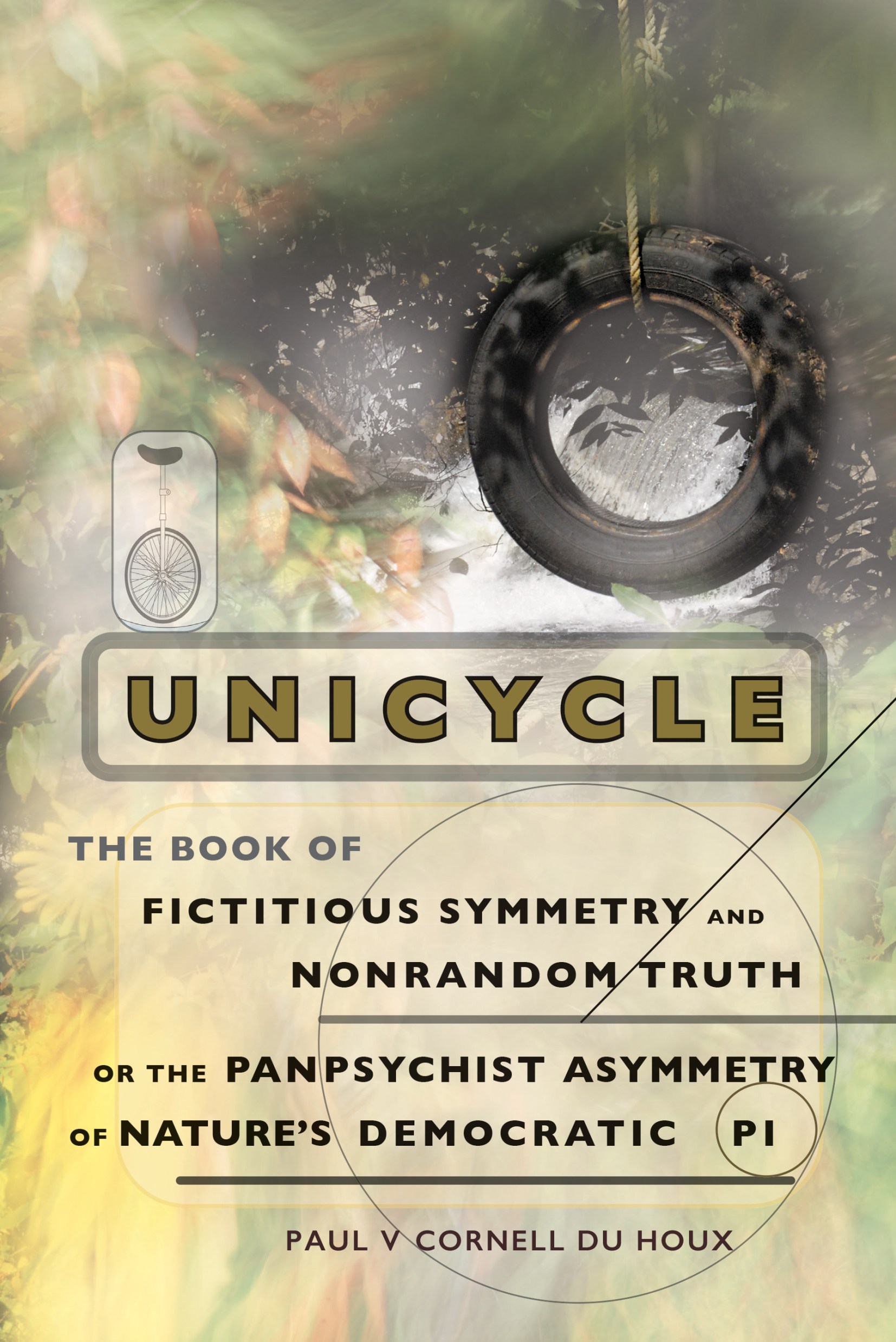
“Panpsychism,” of the curious word coined in the sixteenth century by the rebellious Francesco Patrizi, for the idea that consciousness is all pervasive, advocated by Bertrand Russell and Arthur Eddington in the 1920s—is back! A more developed treatment of the logic of asymmetry, along with illustrative stories and essays, can be found in Unicycle. The sequential numbers herein are a reminder of the deductive tissue, as the logic unfolds.
While the errors are mine, this edition would not exist without my wife, Ramona, who said I should rewrite Yoganomics and explain why. How many times have I announced to her: “It’s done!”
Solon, Maine, February 2024
Catching Up, July 2020
This blog has lain fallow. It’s been over eight years since I posted the text below the line at the end of this update on Yoganomics. Having decided it was just an experiment of my late twenties, I’ve since reconsidered and rewritten the book — forty years later. To say “reconsider” means crediting my wife, Ramona, who reminded me that the original attempt had been worthwhile — to find nature’s moral compass for the economy — now more than ever. And, she added, if I didn’t fix it, the ideas contained, some of them wild enough already, might become feral. Reluctantly, in my late sixties, I had a look at what I had written, back in the late seventies, wondering if it was now altogether too late already. It is difficult to know to what extent one is the product of one’s time and place, how culture-bound one might be, and to what extent one has got free. Ideas I had discarded with that book as foolish now showed up in retrospective context as not only foolish but entrenched, going back beyond the spontaneous regeneration of “self-righting” markets even unto the ancient Wu wei of “effortless action,” or what I had subtitled “pure motion.” Money “just happens.” That said, there is more to Wu wei than the many facile interpretations, not that mine was even conscious. So I was part of something greater, a bigger fool than I even thought, though strangely comforted not to be alone. So I set about making amends with the tools well honed (say I) in Unicycle, the Book of Fictitious Symmetry and Nonrandom Truth, or the Panpsychist Asymmetry of Nature’s Democratic Pi. Yoganomics, the book, might even provide an introduction, a warning in 370 sutras to approach your unicycle with care, especially, like me, if you knew that already.
April 2012 post:
Googling “yoganomics,” there are more and more pages, some with elaborate sites and registered trade marks that are not mine. I am owning up here to having written a book entitled Yoganomics, back in 1979. When a few years later the word “Reaganomics” was being bandied about, I was taken aback. Economics had not yet achieved such humanizing syllables, which would be reconfigured again and again. Obamanomics has got to be the best. Reaganomics was certainly a coincidence, anyway; Yoganomics was still unpublished, back then. In a way I wish it still were. I got it backwards. But it did help me to organize my thoughts.
At Amherst College I had become interested in how the narrow parameters of the economics I was studying seemed to be particularly Western, and I began to look for other cultural values that might highlight new opportunities to view the field. I took some courses and read up on some aspects of the East.
After graduation, my first real job was as an auditor with what was then Price Waterhouse & Co., UK, at the south end of London Bridge. I studied contract law and wondered just when and how a price was really agreed. I got a closer feel for that elusive “elasticity” (or inelasticity) of the intersecting demand and supply curves when I joined the marketing team of the French computer manufacturer, Logabax. Yoganomics was basically just a list — a cascade — of ideas gathered to date, in the summer of ’79.
Since college I had become increasingly impressed by Yoga, especially from the day I stubbed out my last cigarette and never felt the slightest desire for another. After all the years of fighting this addiction, embracing it, and fighting it again, it just stopped. There is of course a smoking story that goes with this event, but not here; fact is, the more I looked for a reason for what seemed a miracle, the more the idea of “substituting behavior” or “changing life style” seemed a likely explanation. Even so, I’m not much of a yogi; shamefully, perhaps, I took what yoga had to offer and ran. I do run back now and then and combine it with other exercises and then Mediterranean food.
So I just wanted to ramble on a bit about yoganomics, since it seems to proliferate, and I don’t know any of the folks involved in whatever has become of the word. I hope they’ve got it the right way round. Hi folks :=) Also, the book, long out of print, sometimes shows up with Unicycle on the immortal Internet. Maybe I should write Yoganomics, the Prequel, and Yoganomics, the Sequel. But when I figured out that the premise of Yoganomics was backwards, I was finally on the road, with Unicycle. Yoganomics inadvertently highlighted our predilection for the paradox of absolutes. Unicycle provides a new solution to an ancient conundrum that is afflicting us today.
One more thing. Yoganomics: Pure Motion and the Law of Economic Erosion was eventually published with illustrations by Justin Williams. The artwork made it all worthwhile. I highly recommend Logicomix, btw, where the comic book idea as applied to an intellectual subject succeeds beyond all absolutes.

 River of Asymmetry